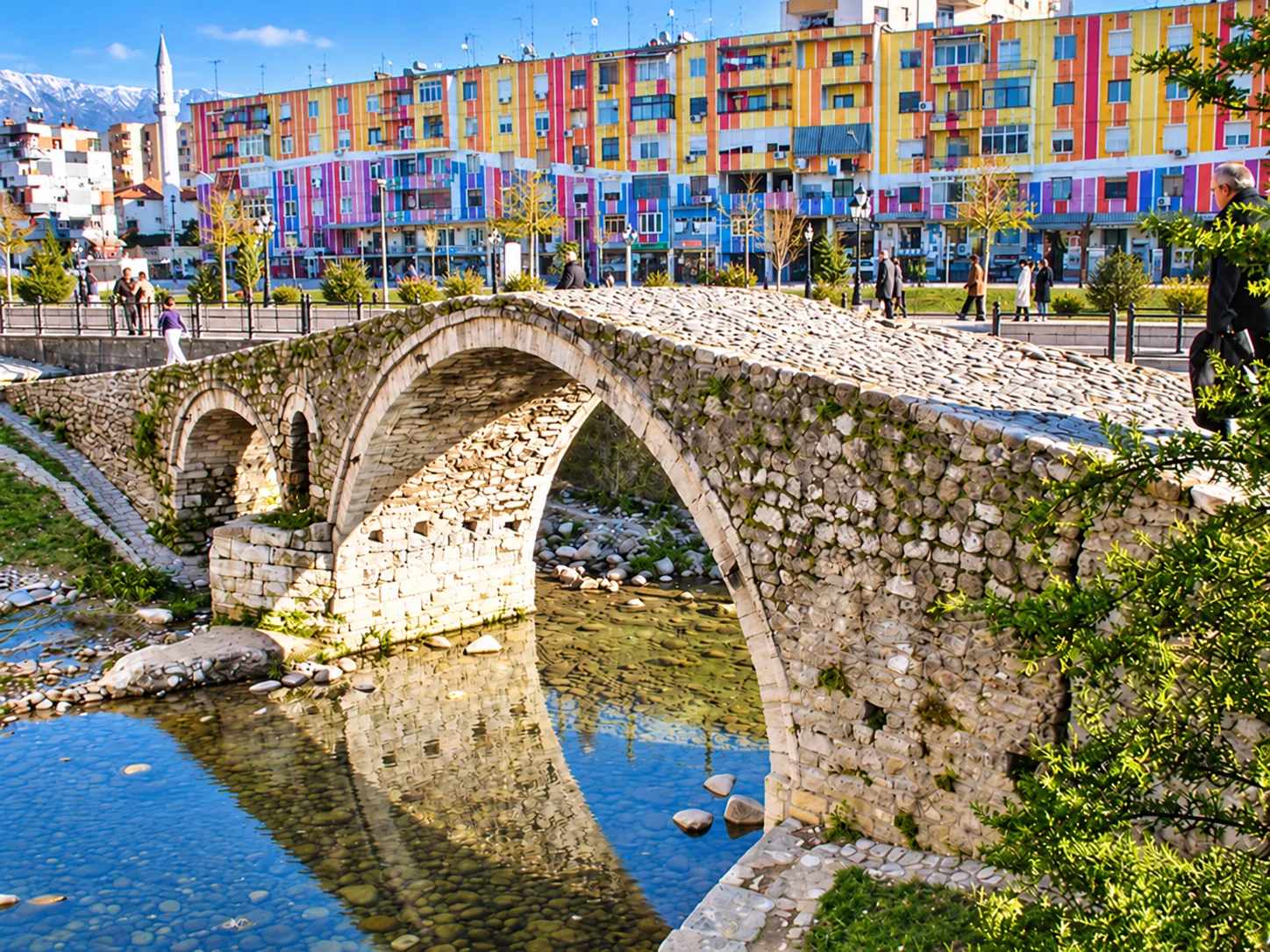
The Tanners’ Bridge (Ura e Tabakëve) is a small 18th-century Ottoman stone footbridge near the Namazgah Mosque, about 8 meters long. It’s a five-minute stop, not a destination, but it’s one of the last pieces of pre-modern Tirana still standing.
| Quick facts | |
|---|---|
| Where | Bulevardi Zhan D’Ark, across from the Namazgah Mosque (Google Maps) |
| Price | Free |
| Time needed | 5–10 minutes |
The bridge was part of the old road that linked Tirana with Dibër and the eastern highlands. Farmers and herders brought produce and livestock into town along it, and it took its name from the tanners and butchers who worked here, by the Lana stream. When the Lana was diverted in the 1930s, the bridge was left standing over nothing and fell apart. It was restored as a pedestrian bridge in the 2000s, with a small pond recreated around it.
The herders who crossed it were part of a way of life that still survives in Albania’s mountains: transhumance, the seasonal movement of flocks between summer and winter pastures. In 2023 UNESCO added “Transhumance, the seasonal droving of livestock” to its list of the Intangible Cultural Heritage of Humanity, in a joint nomination by Albania and nine other European countries (UNESCO decision). The tradition reflects how closely Albanian rural life has followed the cycle of nature: families moved with the seasons, taking their flocks up to mountain pastures as the snow melted and back down to the lowlands before winter, their year shaped by the needs of the animals and the land that fed them.
Combine it with the Namazgah Mosque and Tirana Castle, both within a few minutes’ walk.