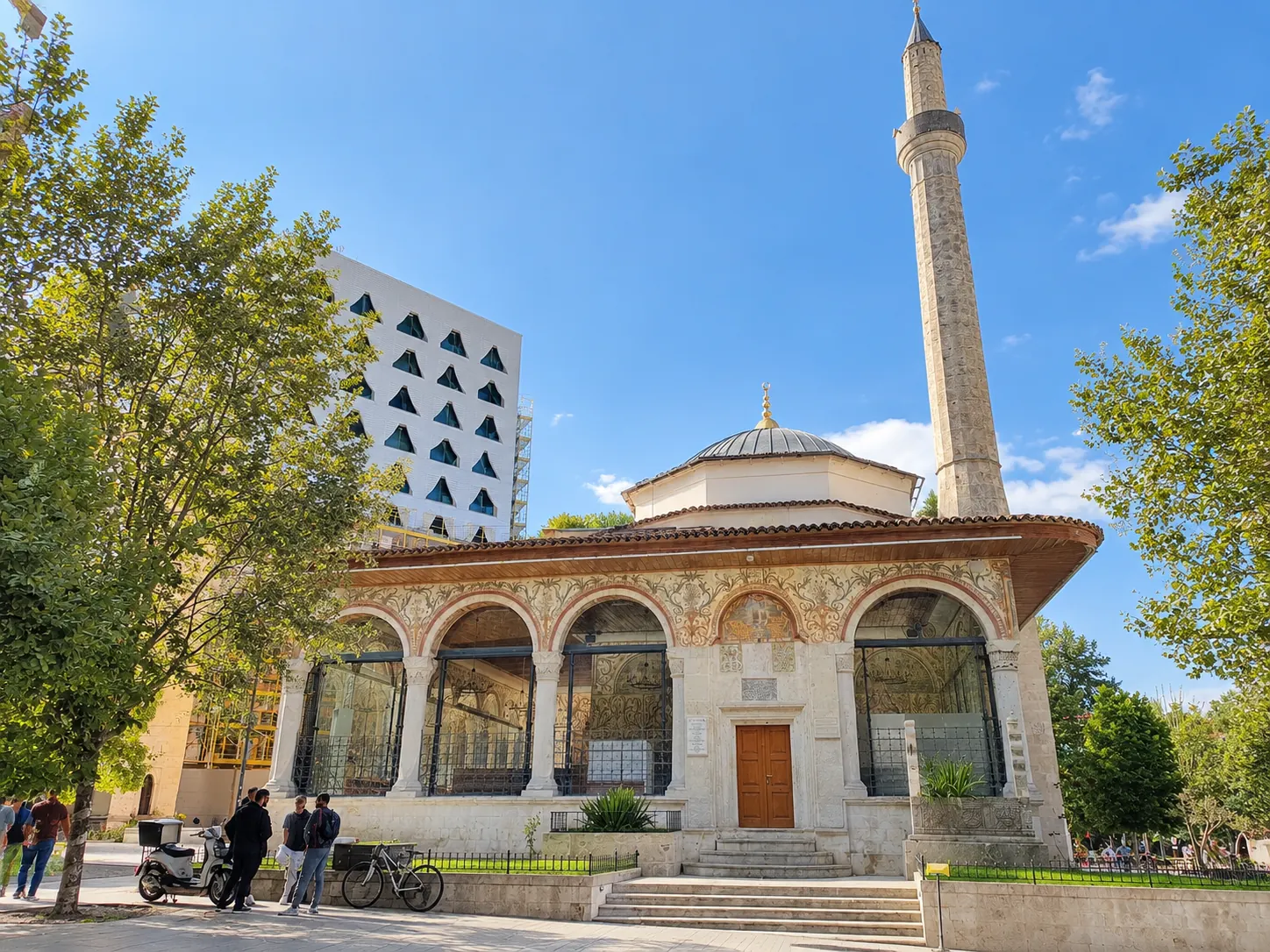
The Et’hem Bej (pronounced ‘bay’) Mosque is a small Ottoman-era mosque on Skanderbeg Square, finished around 1821, and it’s one of the few historic buildings in central Tirana that survived the communist period. Step inside for the frescoes of trees, waterfalls and bridges, which are unusual in Islamic art.
| Quick facts | |
|---|---|
| Where | Sheshi Skënderbej 1, beside the Clock Tower (Google Maps) |
| Price | Free (donations welcome) |
| Hours | Open to visitors between prayer times, roughly 09:00–12:00 and early to late afternoon |
| Time needed | 15–20 minutes |
History
Construction started in the late 18th century under Molla Bej and was completed by his son, Haxhi Et’hem Bej, who also built the Clock Tower next door. During communism, Albania was declared an atheist state in 1967 and the mosque was closed, but it was spared demolition as a cultural monument.
Molla Bej was the great-grandson of Sulejman Pasha Bargjini, the landowner credited with founding Tirana in 1614, so the mosque is closely tied to the town’s founding family. It also wasn’t built as a standalone building. It was the centrepiece of a small religious complex with a madrasa, service buildings and a cemetery, sitting at the edge of Tirana’s Old Bazaar. Most of that disappeared in the 20th century as Skanderbeg Square was redeveloped, and the bazaar itself was cleared around 1959 to make way for the Palace of Culture, leaving the mosque and the Clock Tower as the last pieces of old Tirana on the square.
On 18 January 1991, about 10,000 people walked into the mosque carrying flags, defying the authorities, even though religion was still officially banned. It was one of the moments that showed the regime’s grip was slipping.
The building owes part of its survival to how it was made: a single central dome, thick lime-mortar walls and a slim, tapered minaret. It came through the magnitude 6.4 earthquake of November 2019 largely intact, and a full restoration ran from 2019 to April 2021 with support from Turkey’s development agency, TIKA, cleaning and conserving the frescoes and stonework. The mosque was formally reopened for worship in January 2022 at a ceremony attended by Turkish President Recep Tayyip Erdoğan.
What to look for
The portico and the prayer hall are covered in frescoes: trees, flowers, waterfalls and bridges, painted in soft greens and reds. Islamic tradition usually avoids pictures of living things, which is part of what makes these so interesting.
Friday prayers (Jumu’ah)
Et’hem Bej is still very much a working mosque, and Friday is its busiest day. Jumu’ah, the weekly congregational prayer, generally runs from around 12:00 to 13:30, with the call to prayer and the khutbah (sermon) at about 13:00. The exact time shifts through the year because it follows the local Dhuhr (midday) prayer, so check today’s Tirana prayer times before you go.
As Albanian Night points out, thousands of worshippers still turn up on Fridays. The small prayer hall fills quickly, and the overflow often spreads onto the portico and the pavement beside the Clock Tower. It’s worth seeing from outside, especially knowing that worship here was banned for more than two decades. Visitors aren’t let in during the prayer, so on a Friday come in the morning before noon or wait until mid-afternoon to see the frescoes.
Visiting tips
- Dress modestly. Shoulders and knees should be covered, and women may be asked to cover their hair (scarves are usually available).
- Take your shoes off at the door.
- Avoid prayer times, especially Friday from about 12:00 to 13:30. It’s a working mosque.
For a sense of how much Tirana has changed, walk 10 minutes to the huge new Namazgah Mosque, which opened in 2024.